Thursday night’s Community—the last time I will ever write that sentence—was a three-episode marathon of a season finale. I’m not sure that’s ever been done in the history of TV, and NBC seemed to be confused by it, too—the first episode, “Digital Estate Planning,” aired before a 30 Rock episode, followed by the second two, “The First Chang Dynasty” and “Introduction to Finality.” Here are my thoughts on “Digital Estate Planning,” with the other two to follow tomorrow.
By now, everyone’s heard of the “video game episode”—yes, Community went pixilated. The background is that Pierce asked his father for money to invest in video games way back in 1979. Papa Hawthorne, believing video games to be a passing fad, refuses (“Moist towelettes are sold in nearly every superstore, while arcade after arcade closes down”). Unbeknownst to Pierce, his father develops a massive multiplayer game, with the winner receiving Pierce’s inheritance. Pierce is supposed to bring his seven closest friends, so he shows up with the group (LeVar Burton was a ‘maybe’). Also playing is Gilbert, Papa Hawthorne’s former manservant. Well, the technical term is “assistant,” but given the way Gilbert was treated, he might as well have been a manservant. In a completely expected twist, Gilbert and Pierce are half-brothers—Gilbert’s mother is Pierce’s nanny’s hot cousin.
This episode is simultaneously the most energy the show has devoted to racism, while being a sort-of redemption for its most racist character. In the game, the group spawns in the study room, where they’re attacked by hippies who sex them to death. After getting past them, the first real setting in the game is an archetypal medieval village outside of Hawkthorne Castle, where Pierce’s father rules (cleverly, the Castle is north of the village, implying Papa Hawthorne is even whiter than this town). It’s pretty Zelda-esque and innocently video gamey. Then we learn that the objective of the game is to rescue the white crystal from the black cavern. After leaving the town, they go through a level called “The Valley of Laziness” (made of tacos and topped with a sombrero), “Gay Island” (shaped like a penis), Free Ride Ferry (a wheelchair), and finally to Black Cave, where you ride fried chicken over lava and fight jive turkeys.
By including all of these hateful, uncompassionate stereotypes, we get a more full idea of who Pierce’s father was. Yes, we know he’s a rich, bigoted white supremacist already. But the game takes it to a new extreme. This man wasn’t a casual bigot—xenophobic hate consumed every facet of his life. He couldn’t exist without these Others to keep down.
Walter Isaacson, Steve Jobs’ biographer, talks about how Jobs was a “Product Guy.” He didn’t care about money so much as he cared about making products that would change the world (riches and power and influence were a by-product). He lured Apple CEO John Sculley away from PepsiCo by saying, “Do you want to spend the rest of your life selling sugared water, or do you want a chance to change the world?” Papa Hawthorne was never like that. He wanted the world to stay the exact same as it had been in some imagined past, and he wanted as much power as possible. Building a moist towelette empire isn’t a joke anymore—it’s a character trait.
This environment led to Pierce’s blind fear and hatred. We learn in this episode that Pierce isn’t just racist, he’s mean-spirited. When Hilda’s (Abed’s pixilated love interest) family’s hut burns down (thanks to Annie and Shirley), Pierce says “What’s with St. Pauli Girl?” in response to her tears. For Pierce, everyone needs to be put down, because that’s all he ever heard from his father. Things were so bad, his inheritance isn’t even guaranteed.
The resolution at the end is phenomenal. After winning the game, Gilbert refuses his inheritance because it would mean having to sign a legally binding agreement stating he doesn’t know who his father is. The group forfeits and Pierce tells him to “get in there and kill our dad.” Racist Pierce and jealous Gilbert do the most un-Shakespearian thing possible, embracing one another as brothers and going out for yard-long margaritas (“yard margs”). So yes, on Thursday, Community killed racism. Or did they? Stay tuned!
One last word: This could be the last of Community’s highly ambitious, mess-with-medium projects. With news coming that creator, show runner, and frequent target of praise/snark Dan Harmon would not be returning for season four, it seemed like a send-off for Harmon. It was one more impossibility to cement Harmon’s status as the ambitious show runner to date, just before he lost his baby to a network hell-bent on not catering to its audience. As Kanye West says, “act like you’ll ever be around motherfuckers like this again”—Community will return next season. But episodes like “Digital Estate Planning” probably won’t happen as frequently.

Tuesday, May 22, 2012

Thursday, May 17, 2012
The Failures of Pam Beasley
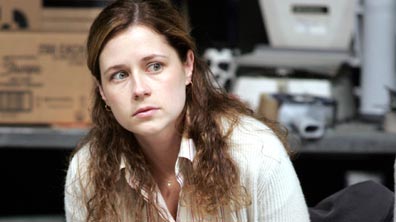
There is nothing as sad as Pam Beasley (unless you count writers who write about fictional characters).
We were introduced to Pam nearly 8 years ago - the drab, every woman. Her romance with Jim was what drove The Office for the first 4 seasons. We had to have someone to root for and rooting for Michael and anyone would be like rooting for a kid to finally stop squeezing that toy Elmo so hard.
Many Office fans suggest that they gave up on the show after Pam and Jim got together, citing a lack of driving force, when in reality The Office just stopped doing comedy after the Jim/Dwight cold open every week. People giving up after Jim and Pam seal the deal indicates that people actually care about these characters. This is understandable when it comes to Jim, he is the conscience of the show, the WTF? is happening when everything around him is literally falling apart. He also has this.
With Pam Beasley-Halpert this reasoning is shady at best. Why do we like this character? No real human man would want to date Pam. Let us list the failures of Pam Beasley.
1. Superiority Complex
While she was introduced as an every woman type character, she has increasingly become more self assured."Character development," you scream, inaccurately! She also seemed to have a nervous tick, and never wanted to cause trouble (including inviting awful people to her own wedding), until she started dating Jim and making Dwight piss in elevators. But where did she get the gaul to make up a job that didn't exist and lie about it for the next 3 seasons? Pam comes off as cold in the first few seasons, stuck in an awful relationship and refusing to do anything about it. There was nothing except for marriage that changed for her, but now, she sits on her throne, eye rolling her hours away next to her husband.
2. Ambition
The superiority complex seems even stranger when you realize that she has failed at maybe everything she has ever done. In season 1 she notes "It's not every girl's dream to grow up and be a receptionist," a wildly accurate statement, that makes you feel for her. She had ambition at one point, she wanted to be an artist, but then she failed out of art school because "she didn't like flash," which is now nearly irrelevant. YOU DIDN'T NEED TO LEARN FLASH. Pam leaves for love, but isn't this the exact advice we steer our friends away from? Don't quit your dream for a guy Pam! Why are we still rooting for this woman, and why do people claim the show gets worse after Pam gets happy? That means we too are happy for this pathetic character.
She returns to Dunder Mifflin as receptionist, grows some balls to leave the company a season later and becomes an awful salesperson at the Michael Scott Paper company. She returns to Dunder Mifflin as an awful salesperson (at least she's consistent) and then makes up the Office Manager job as a weirdly written coup.
Pam had a dream, gave up on it after things got rough, and has now resigned herself to lying her way through a dying company. She's definitely someone you bring home to mom!
3. Looks
Listen, I'm not going to harp on her looks that much, Jenna Fischer is attractive enough, but Pam was intentionally underdone in the first few seasons, before suddenly getting more beautiful and then getting pregnant and staying that way after the baby came out (I might pay for this line later in life). I'm just gonna say she is not hot enough to overlook every other negative attribute.
4. Intangibles
If you were a guy looking to date Pam you do a quick recap. Is she nice? Not really, she's either a pushover that hates her job or someone who does not have patience for your shortcomings (Michael Scott, the guy at the Daycare center, EVERYONE). Is she pretty? Sort of, if she was really smart and kind and funny, sure you could lock it in. Is she smart? You probably have to answer no to this. She couldn't finish art school, her resume reads:
and basically stops there. Is she funny? She's thinks she is funny, that counts for something, I guess...
What this comes down to is Pam has never succeeded at anything, but still thinks she is better than everyone. Not only does she not do well at art school, sales or possibly reception (sometimes she lets it go to voicemail), but she quits all of those things, presumably because she doesn't have the will to overcome ineptitude. So here she is, resigned to a life at a paper company in a paperless world, based out of Scranton, PA, maybe the saddest place outside of the state of Florida. There is nothing as sad as this girl.
RECEPTIONIST - DUNDER MIFFLIN - 2001- INFINITY
and basically stops there. Is she funny? She's thinks she is funny, that counts for something, I guess...
What this comes down to is Pam has never succeeded at anything, but still thinks she is better than everyone. Not only does she not do well at art school, sales or possibly reception (sometimes she lets it go to voicemail), but she quits all of those things, presumably because she doesn't have the will to overcome ineptitude. So here she is, resigned to a life at a paper company in a paperless world, based out of Scranton, PA, maybe the saddest place outside of the state of Florida. There is nothing as sad as this girl.
Tuesday, May 15, 2012
So How Long Have You Needed a Crazy Amount of Help?
Well, everyone, Dan Harmon is perfectly aware of what everyone’s been saying, and the average community college student goes to school for an average of 5-7 years and many schools offer four-year degrees, thank you very much. While you’re questioning his majestic vision, he’s going to take digs at Shutter Island, Robin Williams, One Flew Over the Cuckoo’s Nest, Minority Report, Antiques Roadshow, and worst person in Hollywood Brett Ratner. Never mind how much these are funny and deserved. It seems like Harmon is really feeling backed into a corner, and he's being nasty (hilariously nasty).
And why shouldn’t he? NBC doesn’t care about his show, and he has to continually fight for its life. His contract might not even get renewed next year. How petulant that will make the tone of the show is limitless.
But who cares about the future? This episode was incredible! It was basically “Paradigms of Human Memory”: Redux, but it furthered the overall plot. The group, so shell-shocked and self-pitying after their expulsion, came to terms with how progressively more crazy they’re getting: Abed films Annie when she’s asleep (but not sexually), Britta takes Peyote, Troy spends all of his money on an ATV and then drives it into the school, and Jeff mistakes a dead battery (why does he have that?) for a pack of Lifesavers. They then refocus when they realize that Chang has kidnapped the dean, which is perhaps the best part of the episode. Dean Pelton, who was settling into a comfortable role doing 30-second bits every episode, has finally gained the group’s respect and love (maybe). They even used his name a few times! Amazing.
The subtle genius of doing a clip show of things that never happened has been mentioned before. It shows Harmon and crew’s ambition and talent. Think about it: these are ideas they threw away. A noir paintball episode would’ve been cool, but after previously parodying action thrillers, westerns, and Star Wars, did we need a full noir episode? No. Not even if Abed imagined everything in black and white, which would’ve been cool, but contrived. Britta’s unhinged peyote trip didn’t need any more than five seconds. We didn’t need to see Greendale on fire, just the dean warning the study group first. It’s part of how much Harmon, for all his well-documented dickishness, respects his audience. What other TV show has ever employed the Iceberg Principle better? Hell, it wasn’t that long ago that every TV show actually told you when to laugh. Now, only shows that don’t want to get canceled do that.
Community continued its run of perfect guest stars (Patton Oswalt, Rob Corddry Anthony Michael Hall, LeVar Burton, Jack Black, John Oliver, Theo from The Cosby Show, Sawyer from Lost…) with John Hodgman basically doing his “You’re Welcome” segment from The Daily Show. The setting of leather-chaired psychiatrist’s office (perhaps inspiring Troy and Abed to opt for chocolate milk-filled cognac glasses and a Troy and Abed in the Morning: Nights segment?) seemed exactly like something Chang would dream up, gave us some great “Britta’s trying way too hard at this psychology thing” jokes, allowed Jeff to do a Groucho Marx impression, and is perfect for a clip show. The Greendale Asylum section was hilariously dark—between the weird sephia filter and ghastly sight of Annie maniacally laughing while strapped to a sheetless bed, it was legitimately horrifying. Then they overdubbed Garrett to sound like a smoke-throated doctor from the Mad Men era. Just perfect.
The future looks weird for Community, and by weird, I mean Dan Harmon might not be back and we might get some lame Chevy Chase physical comedy next year. But they seem to be amping up for another strong finish, and that’s what everyone needs to realize: three (maybe four) seasons of this level of high-quality programming is worth enjoying in the present. Maybe ten years from now, after enough internet bitching, Netflix will finance a movie for the Greendale Seven (probably six, there’s no way Pierce has ten more years in him). Just remember that if next season is Community’s last, at least it never lost its power or became a stumbling, phoned-in shadow of itself. Whining about cancellation, like Jeff Winger says, "is a completely unnecessary process...we could just admit the simple fact that one day, something is in your life, and one day, it's not." This is a great, envelope-pushing show, andthe world television is better for its existence. Just enjoy it.
And why shouldn’t he? NBC doesn’t care about his show, and he has to continually fight for its life. His contract might not even get renewed next year. How petulant that will make the tone of the show is limitless.
But who cares about the future? This episode was incredible! It was basically “Paradigms of Human Memory”: Redux, but it furthered the overall plot. The group, so shell-shocked and self-pitying after their expulsion, came to terms with how progressively more crazy they’re getting: Abed films Annie when she’s asleep (but not sexually), Britta takes Peyote, Troy spends all of his money on an ATV and then drives it into the school, and Jeff mistakes a dead battery (why does he have that?) for a pack of Lifesavers. They then refocus when they realize that Chang has kidnapped the dean, which is perhaps the best part of the episode. Dean Pelton, who was settling into a comfortable role doing 30-second bits every episode, has finally gained the group’s respect and love (maybe). They even used his name a few times! Amazing.
The subtle genius of doing a clip show of things that never happened has been mentioned before. It shows Harmon and crew’s ambition and talent. Think about it: these are ideas they threw away. A noir paintball episode would’ve been cool, but after previously parodying action thrillers, westerns, and Star Wars, did we need a full noir episode? No. Not even if Abed imagined everything in black and white, which would’ve been cool, but contrived. Britta’s unhinged peyote trip didn’t need any more than five seconds. We didn’t need to see Greendale on fire, just the dean warning the study group first. It’s part of how much Harmon, for all his well-documented dickishness, respects his audience. What other TV show has ever employed the Iceberg Principle better? Hell, it wasn’t that long ago that every TV show actually told you when to laugh. Now, only shows that don’t want to get canceled do that.
Community continued its run of perfect guest stars (Patton Oswalt, Rob Corddry Anthony Michael Hall, LeVar Burton, Jack Black, John Oliver, Theo from The Cosby Show, Sawyer from Lost…) with John Hodgman basically doing his “You’re Welcome” segment from The Daily Show. The setting of leather-chaired psychiatrist’s office (perhaps inspiring Troy and Abed to opt for chocolate milk-filled cognac glasses and a Troy and Abed in the Morning: Nights segment?) seemed exactly like something Chang would dream up, gave us some great “Britta’s trying way too hard at this psychology thing” jokes, allowed Jeff to do a Groucho Marx impression, and is perfect for a clip show. The Greendale Asylum section was hilariously dark—between the weird sephia filter and ghastly sight of Annie maniacally laughing while strapped to a sheetless bed, it was legitimately horrifying. Then they overdubbed Garrett to sound like a smoke-throated doctor from the Mad Men era. Just perfect.
The future looks weird for Community, and by weird, I mean Dan Harmon might not be back and we might get some lame Chevy Chase physical comedy next year. But they seem to be amping up for another strong finish, and that’s what everyone needs to realize: three (maybe four) seasons of this level of high-quality programming is worth enjoying in the present. Maybe ten years from now, after enough internet bitching, Netflix will finance a movie for the Greendale Seven (probably six, there’s no way Pierce has ten more years in him). Just remember that if next season is Community’s last, at least it never lost its power or became a stumbling, phoned-in shadow of itself. Whining about cancellation, like Jeff Winger says, "is a completely unnecessary process...we could just admit the simple fact that one day, something is in your life, and one day, it's not." This is a great, envelope-pushing show, and
Tuesday, May 08, 2012
Occupy Greendale!
The characters on Community have an amazing ability
to divert any attention away from others and to themselves. The group seems to
proceed as if they actually are the main characters of a sitcom—recall last
week when the smashing of their biology yam brought the entire school to a
screeching halt. This week, as they attempt to cope with the death of
Star-Burns, Britta tries to save the day with her “psychology training,” before
they’re interrupted by the Dean (who finally reveals that he picks out his
outfits before visiting the group). Apparently due to grief over
Starburns’ death by exploding meth lab, Professor Omar from The Wire has
resigned, leaving their grades incomplete and forcing them to make up the
credit over the summer. Jeff nearly Hulks out over his summer being shot.
Shirley wants to have a memorial service—so she can bake some brownies and sing
“Ave Maria.” At the wake, everyone’s eulogy turns into an anti-Greendale screed
based on their personal instances of being wronged by the school. A riot ensues
where the cafeteria is destroyed. The Dean, worrying about things like Subway’s
business and the fate of $50 microphones, authorizes Chang to declare martial
law. The Changlourious Basterds return (Annie: “awww, tiny riot gear”) and
pepper spray the hell out of everyone.
Because they’re the main characters of the show, the
group (now the “Greendale Seven”) faces expulsion for inciting the riot, even
though none of them participated in the violence. They make the logical
decision to try to pin the horrors of the morning on Chang, who gave pre-teens
riot gear and pepper spray. The Dean decides to back them (he knows if they’re
expelled, he’ll never have another opportunity to stand between Jeff and Troy
in a group hug again), but he accidentally gives his testimony up to Chang.
Greendale’s new presumptive dictator has already manufactured a fake dean, and
he knocks the real one out with a tranquilizer. The group gets expelled, goes
home, orders pizza, and Annie starts drinking. Troy rallies them, and there’s a
classic sitcom “at least we have each other” moment where everyone glances
around meaningfully and chomps down on pizza.
This is another instance of Community falsifying a
moment and misdirecting its audience. Yes, it's nice to see that the group loves
each other, but they've lost their only real reason for hanging out together. From
the upcoming episode titles (this week was “Course Listing Unavailable,” next
week is “Curriculum Unavailable” followed by “The First Chang Dynasty”), it’s
hard to think that this will be resolved as quickly as the Troy and Abed Civil
War.
It’s impossible to watch this episode without
thinking about Occupy Wall Street, particularly Occupy Oakland. The study group
is angered by a circumstance they can’t control—their credit is only invalid
because the Dean doesn’t know how to administrate a school. It’s not like Professor
Omar from The Wire is the only biology professor on campus. Another professor
could step in and administer a final exam. Not hard. At the wake, Shirley is
angry because she had an idea to open a sandwich shop in the cafeteria. Shirley is at Greendale to learn how to run a business, and when presented with
an opportunity, she’s outbid by a giant corporation so ominously powerful they’ve
actually possessed a human being. Troy and Abed are our equivalent of Occupy
drum circlers—they don’t really have a horse in the race, they just want to do
the rather 80s chant of “When I say ‘Greendale’, you say ‘sucks!’” Pierce is
That Guy, the one who doesn’t know what he’s mad about, but he’s been mad for a
long time, so he just yells “Let’s burn this mother down!”, which is what
prompts the cafeteria to explode with violent students.
The Dean, completely unable to admit his mistakes
and nervous of the consequences, makes no effort to understand the students’
grievances or even talk to them. He can’t understand why anyone would be
unhappy at his school, and to be fair, there is no one specific demand that the
rioting students make (much like OWS and its many factions). They just want bureaucratic competency, decent opportunities, and their summer back. This
being Greendale, that just ain’t gonna happen.
While this week’s episode was excellent and leads to
some intriguing plot developments, it begs a few questions. Is it not too soon
to make jokes about the merciless pepper-spraying of peaceful protesters? I
think Harmon and crew did it subtlety enough, but it could’ve used more development and maybe less frivolity.
And the question that applies to Occupiers also applies to the “Greendale Seven”:
what’s your next move? Winter is over and it’s an election year—are the
protests still relevant and necessary? (Yes). Chang may have manipulated the school
board and gotten you expelled, but are you going to let your lives “get
double-ruined,” as Annie says before taking a shot? Harmon and crew seem to be
gearing up for another epic end to the season. It will be interesting to see if they can deal with a more contemporary setting, rather than mimicking genre
pieces.
Tuesday, May 01, 2012
Community: An Uncannily Topical Episode on a 21-Year-Old TV Franchise
We knew we were getting a Law and Order episode ever since the trailer for the Great Community Return, but it took them so long to get to it that I’d forgotten about it entirely. I’d guessed it was going to be a subplot of an episode, not an entire episode. But Dan Harmon wanted to get his Dick Wolf on, and the result was the most Community of Community episodes ever, even though it wasn’t a Community episode (get it?).
The case against Law and Order is pretty easy to make. It’s a show that uses pop psychology, ripped-from-the-textbook straw characters, and a trivialized depiction of the criminal justice system where murderers, rapists, child molesters, and murdering child rapists are indentified, arrested, and tried within 40 minutes. Sort of makes those assholes on The Wire seem really bad at their jobs, right?
Speaking of The Wire, Omar! Omar, muthafuckas, OMAR! Michael K. Williams returned this week as Professor Kane, the dude learned got a PhD in biology while in prison. I mentioned last week how him having the flu was a major fan disservice. I should’ve known that Harmon and crew were foreshadowing his return this week.
As is befitting a Law and Order episode, all of the characters quickly fall into stereotypes: Jeff and Annie as the lawyers (one hotshot, one super motivated), Shirley becomes the sassy Danny Glover “I’m too old for this shit” character, Britta as the in-lab technology nerd (which, for Britta, just means using Instagram), Pierce as the old snitch running a cop-tolerated gambling ring, and Troy and Abed as cop partners quasi-fighting over who’s turn it is to say the zinger.
A great thing this episode does is bring back a whole slew of peripheral characters, who also fall into stereotypes. The two janitors appear at the beginning of the episode in the “working class stiffs who discover the body and then are never seen or heard from again.” Gary (the fat guy who isn’t Neil) is the guy who runs shitty hot dog stand. Real Neil With Pipes of Steel (nee Fat Neil) is the administrative person who somehow knows about the case but isn’t a real suspect. Starburns is the guy who you think has done it all along but really isn’t the culprit. Magnitude! is another early suspect. Todd, whom Pierce ditched as a biology partner early in the season, has a large role, and even Vicki returns.
You could write a lot on hilarious things Troy and Abed do in this episode, but I’ll keep it brief: Troy wears a Spiderman tie throughout (Donald for Spiderman!), Abed actually says “he’s a bad cop. I’m a good cop,” and when they discover the dead yam late at night, Abed shows up in a T-shirt, hoodie, and boxers. Classic stuff.
Anyway, at the end of the episode, you’re reminded exactly how ridiculous all of this is. Professor Kane is not amused by the group’s “investigation,” but he plays along because he knows it’s the only way to get Annie Adderall to shut the hell up. Professor Kane, who spent twenty-five years in prison, even says, “Need I remind you that this is not a courtroom?” Kane is played by Michael K. Williams, who actually got that giant scar across his face on his 25th birthday. He also portrayed the President of the United States’ favorite character on the best, most realistic cop show of all time. Omar even gets misquoted in this episode—Kane and Jeff both say “Man gotta have a code” (after which Dean Pelton says “Awesome!”) at separate times. But the Omar quote is the less ebonic “A man must have a code.”
The episode is a mockery of the criminal justice system, and it gestures towards that fact. L&O is a mockery of the criminal justice system, and Community is making a mockery of that mockery. Honestly, even if we follow the internal logic of the episode, it doesn’t even hold up as a crime drama. We never knew that yam existed before, and it’s a yam, for crissakes, so who really cares if it’s been murdered?
It’s also impossible to watch this episode without thinking of the recent dustup between Grantland’s Wire character bracket and Wire creator David Simon. Simon made some tone-deaf comments to the media, and Bill Simmons called him a “condescending, humorless blowhard.” Then Simon got a blog to clarify his comments, basically saying that The Wire raised too many important questions to be “[hacked]…into pop culture nuggets.”
Neither is wrong, of course. Simon is a bit of a dick (but he’s not the only TV show creator I wouldn’t necessarily like to have a beer with), but he’s right that The Wire is about more than just the best character (obviously it’s between Omar, Avon, Stringer, and McNulty, and it’s probably Stringer, but whatevs). All of this is a necessary and uncannily timely background to Community’s Law and Order episode. If The Wire (or, you know, walking around some rough-looking city streets and speaking to members of your community) tells us anything, it’s that moral relativism is the law of the land. America isn’t a fair country, and when you consider everything, there aren’t really any good guys or bad guys. What L&O tells us is that cops always want to catch bad guys, and bad people are just bad, end of sentence. Community, in its self-possessed, hyper-referential way, made an episode about how dangerous and artistically stupid that is. I don’t know if this episode would seem as relevant without the Simmons/Simon dustup, but hey, maybe Dan Harmon can see the future.
Subscribe to:
Posts (Atom)